

The core theme of this battle is that GLP-1 agonists operate through a forced shutdown mechanism that induces artificial suppression of the innate human survival biology—specifically the Leptin/Ghrelin axis—and a total collapse of metabolic adaptability.
The starting point of this battlefield is the pathetic reality where those who’ve gorged themselves on garbage and realized the consequences too late finally cling to the choice of a single pin.
It is flat-out nauseating to hear people rattle off names like Ozempic, Wegovy, or Saxenda as if they’ve discovered some magic elixir that melts fat away.
That drug you’re trying to pin into your body isn’t some smart bomb precision-engineered to target and burn only fat.
It is a blatant act of biological interference that chemically neutralizes the survival signaling systems your body has clung to until the very end.
Misinterpreting this as mere appetite suppression is a dangerous delusion.
You aren’t “not hungry”; you are in a state of functional paralysis caused by the forced occupation of your satiety centers and the physical inhibition of gastrointestinal motility.
Wrapped in the sweet phrasing of “improving insulin resistance,” the reality of this drug is a forced external regulation of the entire hormonal feedback system, including the insulin/glucagon axis.
Forcing hormonal signals to linger when they should naturally be degraded and gone is a direct disruption of the body’s homeostatic maintenance mechanisms.
This isn’t a process of losing weight; it’s a process of paying back the debt accumulated in a metabolic system you personally trashed.
There is no such thing as a free lunch in this world.
The price will be paid, and it will be extracted by grinding down your muscles, your nervous system, and your hormonal axes.
Now, open your eyes and witness exactly how GLP-1—this high-efficiency regulator—encroaches upon and reshapes the body’s energy homeostasis network.

The fight begins the moment you treat drugs like soldiers and deploy them in the center of the battlefield.
A GLP-1 analog is a targeted regulator that precisely inhibits glucagon secretion from pancreatic alpha cells while simultaneously acting as a physical roadblock that slows down gastric motility.
The moment you define this drug as a simple appetite suppressant, your tactical understanding is already over; its true nature is a hormonal feedback control device that blocks glucagon secretion and forces insulin release.
The 0.25mg or 0.5mg settings on a Novo Nordisk Ozempic pen aren’t just arbitrary numbers.
Those figures represent a calculated chemical tactic to excessively prolong the “food intake” signal to the L-cells.
No food has actually entered, yet insulin secretion is promoted, and glucagon’s command to mobilize stored energy is suppressed—a classic distortion of the hormonal axis.
The dosing schedule seems like a simple “once a week” rule, but during that long half-life, the body is trapped in a chemical state of continuous, amplified satiety signals.
Physically slowing gastric emptying alters digestive efficiency and, if unmanaged, serves as the starting line for functional dyspepsia.
The target is clear from start to finish.
Intensely stimulate GLP-1 receptors in the hypothalamus’s appetite center and slow down gastric peristalsis.
As receptor occupancy rises, the body shifts into a state where the physiological pathways for recognizing actual energy deficits are suppressed, even when in a true deficit.
If you want to use this properly, you don’t just stick the needle in; you must secure a supply route for nutrients to pass through this forcibly slowed digestive tract.
Digestive enzymes, stomach acid supplements, and a deliberately designed forced-feeding schedule are essential equipment in this operation.
Numbers never lie.
Realize clearly that for the sake of “blood sugar stability,” you are simultaneously manipulating and disrupting multiple physiological signaling pathways.

Let’s look at a real-world battlefield case.
Chul-su, a 29-year-old bodybuilding hopeful at 18% body fat, blinded by the desire to cut, pinned a full 1mg of a GLP-1 analog per week.
24 hours after the start of combat, the first feedback hits: pure nausea.
It’s not that his appetite is gone; the moment the scent of food passes by, his brain fires an immediate rejection signal.
By the 48-hour mark, gastrointestinal movement becomes extremely slow.
The 150g of chicken breast Chul-su forced down is still sitting in his stomach 6 hours later.
As protein absorption is delayed, blood amino acid concentrations hit rock bottom.
Consequently, the nitrogen balance within the muscles shifts directly into the negative.
After 72 hours, the scale weight is down, but Chul-su’s body in the mirror looks flat and deflated.
Since glycogen storage is non-existent, the pump is absolutely zero.
Even when he hammers the dumbbells in the gym, veins don’t pop; only skin hangs loose.
This isn’t a scene of fat loss; it’s the depletion of glycogen and water attached to the muscle.
Entering Week 2, Chul-su’s girlfriend speaks up:
“Baby, your breath smells sickly sweet, and why do you look so dead?”
This is a sign of changes in oral bacterial balance and a systemic drop in energy metabolism.
It might not be due to ketones, but rather excessive fermentation of stomach contents due to delayed digestion and electrolyte imbalances.
Libido hits rock bottom.
Not just because of lower testosterone, but because the resources allocated to the reproductive instinct have been cut off due to the overall drop in energy availability.
Week 4 blood work comes back: AST 82, ALT 95.
Elevated liver enzymes are the liver’s stress response to nutrient deficiency and drug metabolic load.
While the brain is secreting cortisol in response to nutrient deprivation signals, GLP-1 is sending satiety signals, causing a total system crash.
Ultimately, Chul-su’s bench press max drops by 20kg, and his irritable reactions ruin his personal relationships.
At a company dinner, picking at his food leads his boss to ask, “Are you sick?” leaving him with a deep sense of defeat.
This isn’t a controlled diet; it’s an indiscriminate assault on the physiological system.
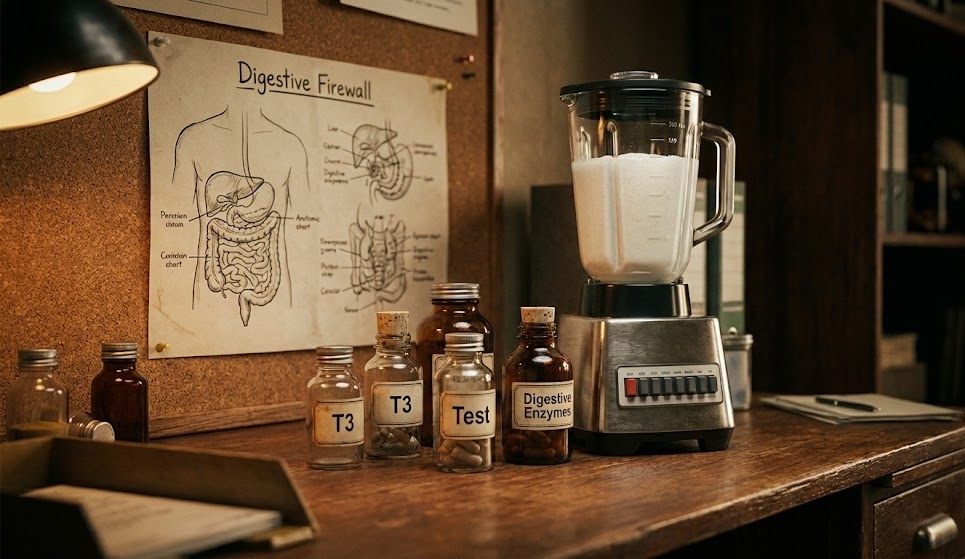
If you’re going to step into this hellish battlefield with the name GLP-1, never jump into enemy territory empty-handed and unprepared.
That’s not an option; it’s a suicide route that will break your body’s system in the fastest, most certain way possible.
The front lines must be reinforced with a defensive line first; this is an ironclad rule, not just a strategy.
Your first task is to build a solid pro-anabolic foundation—in other words, a biochemical fortress that won’t easily crumble under external shocks.
A number like 250mg of Testosterone is just a guard at the entrance; the real battle begins behind that.
The key is to stack your anabolics precisely according to your individual receptor response and metabolic rate to create a stable territory where energy is high and muscle is preserved.
Depending on the situation, GH might be necessary, and in extreme cases, even insulin must be considered, but there is no universal formula here.
Every battlefield is individual.
And never forget the shield that is the thyroid.
Don’t respond only when you hear the sound of your metabolic rate collapsing; set up T3 at 12.5 to 25mcg or a preventive T4 assist before that sound even begins.
This is the strategy of installing a fire hydrant before the fire breaks out, rather than spraying water after the fact.
Next is the firewall of the digestive tract.
On the GLP-1 battlefield, the stomach is the first to be neutralized.
There’s no reason to just watch it happen.
You must arm your gut before the enemy does by pre-stacking probiotics, Betaine HCL, digestive enzymes, and even gastroprokinetic agents like Domperidone.
If the stomach isn’t functioning, don’t wait for it physiologically; make it move by force, even through chemical and mechanical means.
Only after this defensive line is built are you qualified to enter the main topic: the GLP-1 protocol.
GLP-1 analogs like Semaglutide must start at a minimum of 0.25mg per week, and increasing the dose isn’t a rule—it’s a taboo.
The moment you touch it, the drug begins to rule the battle.
And the true core of this war is the nutrient deployment strategy.
If you still think solid meals are the default, discard that thought immediately.
Shoving solid chunks like meat into a gastrointestinal tract that’s already slowed down is like jamming iron shells into a broken tank.
Instead, create a complete liquid meal by mixing hydrolyzed whey protein (WPH) with MCT oil and dextrin or maltodextrin powder.
This must be forcibly injected every 2 to 3 hours to push absorption efficiency to the extreme.
Simultaneously, drink EAAs or BCAAs with Glutamine throughout the day to continuously block catabolic signals with an amino acid bombardment, protecting that final defensive line: the gut wall.

In this entire process, the moment you ignore the signals your body is sending, it’s no longer a strategy; it’s a gamble.
If weekly weight loss exceeds 0.8% or weekly strength drops by more than 5%, that is a clear red alert.
You must immediately consider reducing the dose or halting the protocol altogether.
If bloating becomes severe, nausea persists for over 48 hours, or urine turns dark, there’s no need for discussion.
That is the point where you must stop immediately, activate gastroprokinetics, and flood the system with hydration and electrolytes.
The most important yet most ignored part of this war is the exit and recovery.
If you fail to manage the rebound after finishing the cycle, everything you’ve built will collapse at once.
You must follow the procedure of tapering the dose according to the drug’s half-life, and the work of re-educating the suppressed Ghrelin receptors begins the moment you stop the GLP-1.
Maintain total calories but transition carbohydrate sources stepwise from brown rice to potatoes, then back to dextrin, adjusting meal frequency to reawaken insulin sensitivity.
T3 or T4 used preventatively must also be withdrawn slowly.
Simultaneously, you must intentionally spike your daily activity levels (NEAT) to rekindle the spark of your basal metabolic rate.
Without this entire narrative, without the full picture of the battlefield, simply sticking a needle in is nothing more than self-harm, pushing your body into a physiological quagmire from which there is no return.
The end of that path is only ruins—no results, no recovery, no control.
But there is one thing more dangerous than building a defensive line.
The question of who is truly controlling this system above all this biochemical warfare.
GLP-1 is not just a drug; it’s a system disruptor, and it tends to disrupt your personality, stress response, and even obsessive tendencies.
Never forget that the moment you feel you are in perfect control, a collapse of mental control—which blood tests will never catch—can arrive before the collapse of your body.
Therefore, the true security point isn’t the dosage or the tech of the stack; it’s that the moment you use GLP-1, you absolutely need an external set of eyes.
You must be in a structure where everything—food intake, weight, training performance, and even the smallest cracks in your emotional state—is monitored.
That sense of relief, feeling like things are going well, is the most dangerous trap.
This war is one that silently dismantles your final line of defense—your own judgment—before it takes your body.
If you don’t realize that, even the most sophisticated protocol is just another shortcut to self-destruction.

The body never lies.
The moment you try to cheat the system, the body will demand payment for the sake of survival.
GLP-1 is not a revolutionary salvation; it is a debt that must be accompanied by precise management and eventually repaid.
When you forcibly turn off the physiological alarm of hunger, the power to the life-support system known as energy homeostasis also becomes unstable.
The battlefield isn’t just a numbers game calculated by body fat percentages.
It refers to a state of total control where every blood vessel and every drop of hormone works in organic harmony.
Don’t mistake a lack of symptoms for a healthy system.
Just as a heart is quiet until a heart attack strikes, GLP-1 quietly eats away at your muscle and organ function until the metabolic system is completely disrupted.
The explosion of food cravings and weight fluctuations the moment you stop the drug aren’t because your willpower is weak.
It’s because physiological compensation begins as a result of ignoring survival biology and deceiving the body’s signaling system.
A true warrior does not hide behind drugs to evade responsibility.
Control the drug; become the master of the system.
A diet that fails to protect muscle is a war already lost.
Listen to the signals your body sends.
That is the only answer, and the only philosophy.