It was the tail-end of the prep season.
Unexplained systemic inflammation blew up in the quads and front delts, completely derailing everything at the most critical moment.
At first, everyone thought it was just standard PIP (Post-Injection Pain).
But it wasn’t.
Toxic compounds, generated by prolonged contact between the solvent and the plastic, were continuously irritating the muscle cells themselves.
Let’s trace back to exactly why this happened.
The internet is still swarming with “gurus” claiming you can pre-load a week’s worth of syringes and just pin one on the go.
Trash-tier bodybuilding communities parrot this recklessly.
Chul-soo bought into that BS completely.
That was the beginning of the end.
At a level where you need to manage receptor states and precisely control hormone feedback loops, this negligent storage protocol is no different from injecting contaminants straight into your own system.
No matter how well you handle a weapon, if the weapon itself is compromised, the outcome is obvious.
You end up like Chul-soo.

To view chemical deployment as a battlefield: AAS are the strike force breaching enemy lines, and HGH is the aerial drone orchestrating the entire theater of war.
Insulin and peptides are the supply lines pushing energy to the front.
To command these assets properly, you must absolutely lock down their storage environment prior to administration.
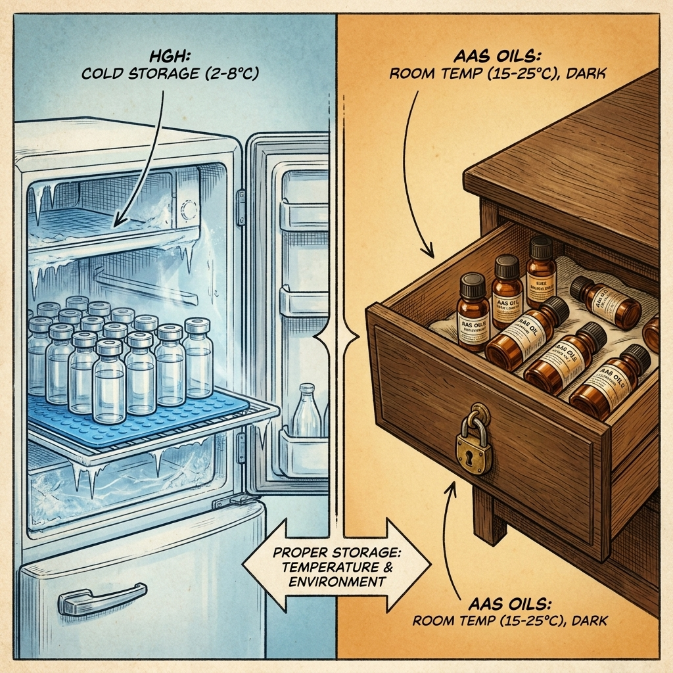
Protein-based assets like HGH, Insulin, BPC-157, and GLP-1 agonists require strict refrigeration.
We aren’t just talking about keeping them cold.
It’s about preventing temperature fluctuations from degrading the hormone’s molecular structure itself.
Pharma-grade HGH like Nutropin or Genotropin theoretically state they can be stored at room temperature.
But in an environment where the AC turns off and room temp spikes from 22°C to 35°C in a flash?
Those expensive peptide chains just snap.
They get neutralized.
Reconstituted HGH suffers peptide chain damage just from the vibration of opening and closing the fridge door.
Store it horizontally on a silicone pad deep inside the fridge, and never use the door shelves.
And while HGH reconstituted with bacteriostatic saline must be used within 14 days, reconstituting it with an acetic acid buffer solution keeps it stable for 30 days at 25°C room temp.
Set it up this way if long-term storage is necessary.
Conversely, AAS compounds must absolutely never be refrigerated.
Refrigeration causes the compound to separate from the solution, leading to crystallization—aka crashing.
Heating crashed oil to salvage it, refrigerating it again, having it crash again—repeating this completely destroys the chemical bonds of the carrier oil.
Pinning it in that state is a one-way ticket to sterile inflammation.
Heavy carrier oils like castor oil, commonly used for Testosterone Enanthate, become insanely viscous below 5°C.
It becomes physically difficult to push through a needle.
There are guys harpooning themselves with 18G or 16G needles to force it in, but all that leaves you with is scar tissue and a severe limp.
Don’t ruin the oil by refrigerating and shaking it for no reason; just store steroid oils in a dark, temperature-stable place.
A personal drawer or safe is more than enough.
Breaking down field data, plastic degradation risks and safe pre-loading durations vary wildly depending on the carrier oil.
But we need to go one step deeper here.
Not all plastics are created equal.
You need to understand that chemical resistance differs drastically based on the syringe material.
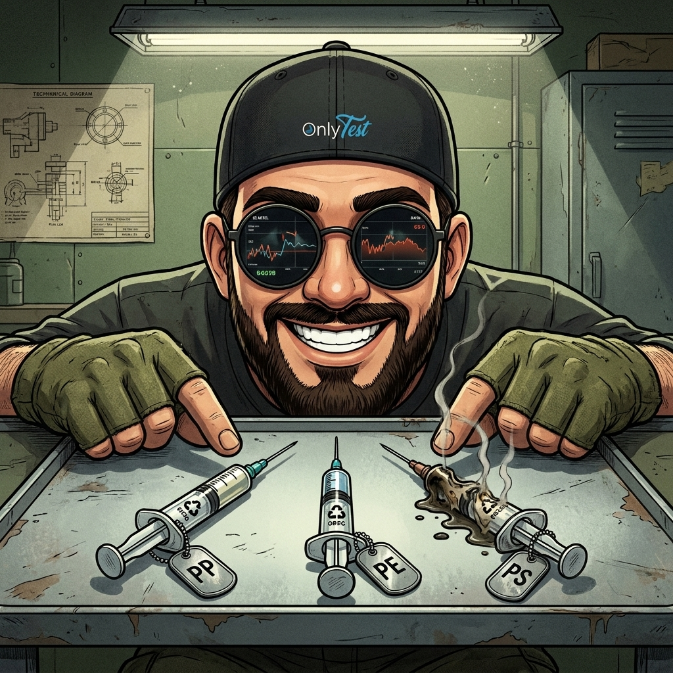
Polypropylene (PP) is the toughest.
It can somewhat withstand Ethyl Oleate (EO) and endures prolonged contact with MCT oil.
If the bottom of the syringe has a ‘5’ inside a triangle (△), it’s PP.
Seek these out and use them.
Polyethylene (PE) is middle-of-the-road.
It handles standard oils fine but is weak against solvents with a high Benzyl Benzoate (BB) ratio.
Most insulin syringes (slin pins) are made of this.
Do not pre-load them for more than 3 days.
Never, under any circumstances, use Polystyrene (PS).
It turns to mush in 24 hours.
You sometimes see this in lab consumables or dirt-cheap syringes; if you spot it, trash it.
It’s a material utterly unfit to hold gear.
Make it a habit to check the material code on the bottom every time you buy syringes.
PP is top priority, PE is secondary, PS goes straight in the trash.
The syringes Chul-soo used didn’t even have a material code.
Now let’s look at the data by carrier oil.
MCT oil has a low risk of plastic degradation and doesn’t crystallize when refrigerated.
Pre-loading is recommended for no more than 3 days.
However, long-term degradation of the rubber stopper still requires further verification.
Pairing it with a PP syringe is the most stable combo.
Grapeseed Oil (GSO) has a moderate degradation risk.
It gets thick below 10°C, and max pre-loading is 5 days.
But this is strictly for organic oils with a low solvent ratio.
Don’t keep it in a PE syringe for more than 3 days.
Castor oil has a low degradation risk.
But below 5°C, it congeals to a point where injecting is physically impossible.
In the field, it’s generally run for up to 7 days without major issues.
Bayer products like Testoviron and Primobolan use this standard.
It pairs well with PP syringes.
You need to be extremely careful with Ethyl Oleate (EO).
The risk of plastic degradation is extremely high, and it rapidly melts rubber.
Absolutely NO pre-loading.
Even under 24 hours is risky.
Not even with a PP syringe.
If you see the ink on the syringe barrel dissolving, immediately scrap the whole batch.
Cottonseed oil has a low degradation risk but can form precipitates below 10°C.
Pre-loading up to 5 days is doable, but it’s hard to even find these days.
It’s an old-school method used in legacy European formulations.
Sesame oil has a low degradation risk and is practically unaffected by refrigeration.
Pre-loading up to 4 days.
It’s just used by a minority of domestic UGLs, and long-term data is lacking.
The conclusion is simple.
If pre-loading is unavoidable, use MCT or Castor oil gear in PP syringes, load only 3 days’ worth, and store them vertically.
Pre-loading is completely banned for EO-based gear.

Let’s get back to Chul-soo.
His protocol was micro-dosing a 1.2ml Bayer Testoviron ampoule into 0.3ml shots three times a week.
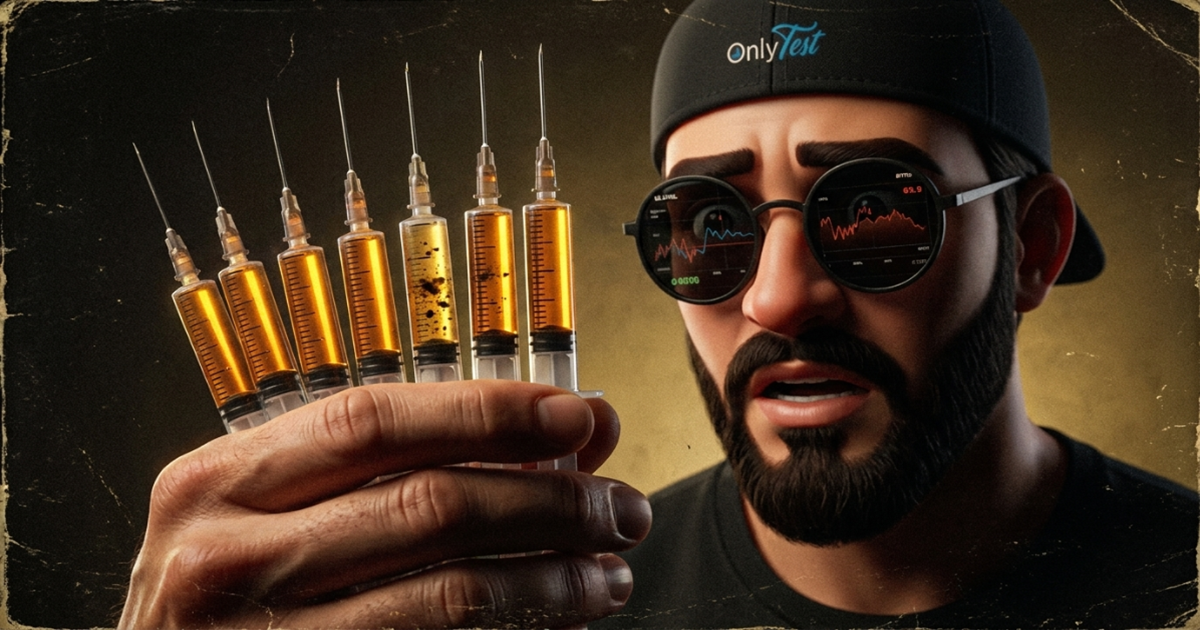
To preserve the rest after breaking the amp, he pre-loaded it into four plastic syringes, even stacking 1.2ml of Primobolan in them, stockpiling a 2-week supply.
Since it was a combo of castor oil, BB, and BA, it looked completely fine sitting in the plastic syringe for 2 weeks on the surface.
But the syringes Chul-soo used were cheap PS-grade, and he had no idea.
The blowout happened from a completely different vector.
Some UGL gear, batches using EO or harsh synthetic carrier oils, possess aggressive solvent properties that literally make the ink on the outside of the syringe barrel run.
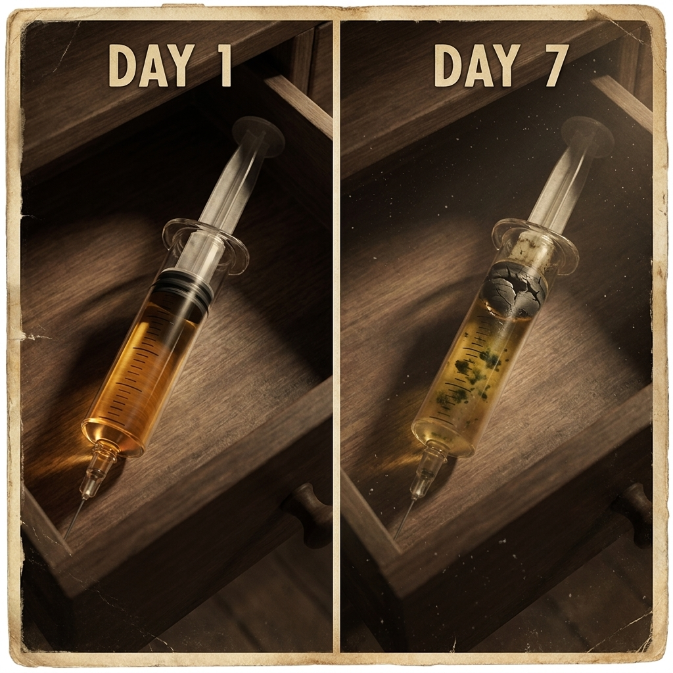
That solvent sat inside the plastic syringe for over a week, slowly dissolving the black rubber stopper at the end of the plunger.
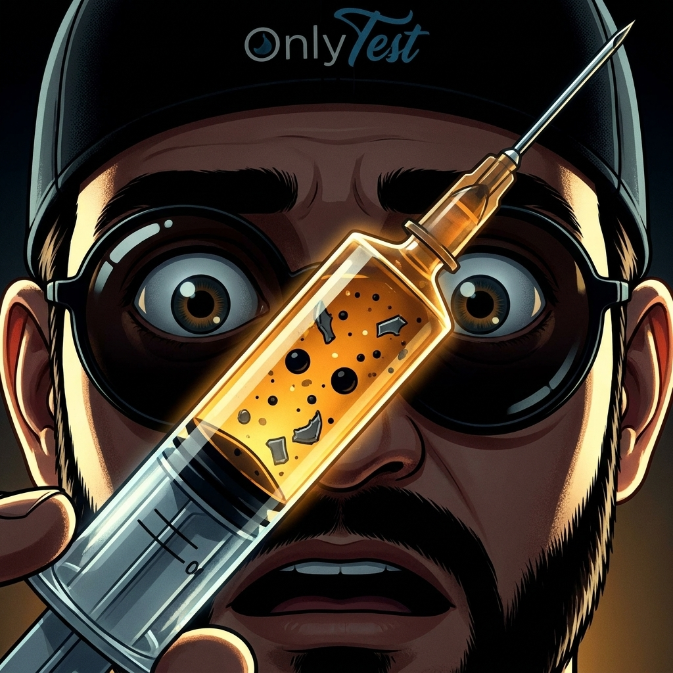
Right before pinning, what Chul-soo actually saw was plastic and rubber debris floating in the oil, slowly creeping up toward the needle tip.
If that had been pushed straight into his quad or delt vascular system?
His immune system would have triggered a massive acute response, AST and ALT liver enzymes would have skyrocketed, and a systemic inflammatory cascade would have blown up.
Luckily, he aborted the injection immediately and scrapped the entire batch, dodging the worst-case scenario.
The people on the internet whispering to pre-load a week’s worth of slin pins will pay the price of plastic toxicity leaching in by the time they hit their third shot.
Because most slin pins are PE material, the contact area between the plunger rubber and the oil is larger than standard syringes, meaning the degradation rate is significantly faster.
Pre-loading past 3 days causes micro-particles to flake off the rubber stopper surface, contaminating the peptide solution.
I see guys ruining expensive peptides like BPC-157 or GLP-1 agonists like this every single week.
The gold standard is keeping everything preserved inside glass vials or ampoules right up until the moment of injection
Do you know why first-world pharma formulations or highly reputable UGLs can guarantee 3 to 5-year shelf lives?
Because they isolate the active compounds in specialized glass containers, not plastic.
But realistically, given Korea’s strict prescription environment or the limitations of micro-dosing ampoules, there are situations where you have to transfer them beforehand.
Here is the concrete tactical protocol that bodybuilders actually run in these scenarios.
First, secure sterile glass vials.
Source 2ml or 5ml sterile glass vials from vet supply shops or online research chemical vendors.
Brand doesn’t matter.
As long as it’s sterile and the rubber stopper is solid, you’re good.
You can even search “sterile vial” on Coupang and find them.
Search “sterile glass vial” on AliExpress, and you can get a 10-pack for around 20 bucks.
Second, filter needles.
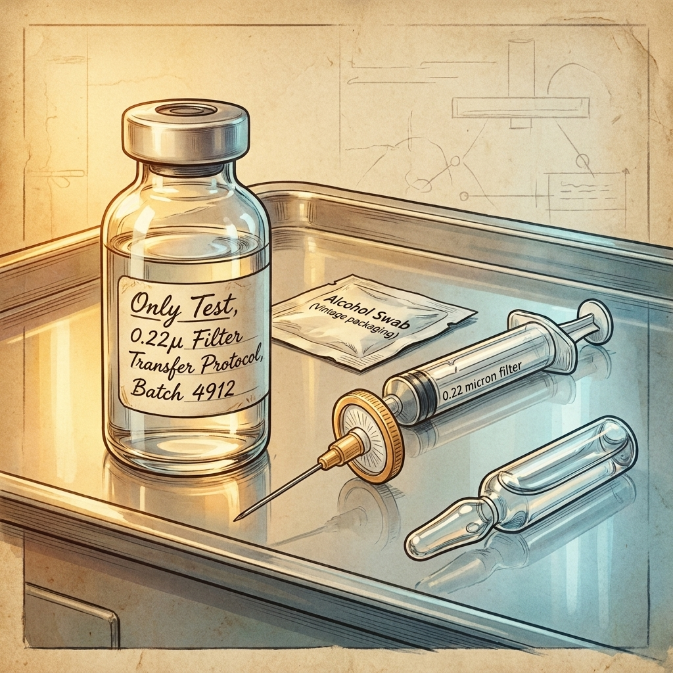
These are syringes equipped with a 0.22-micron filter, which sift out the microscopic glass shards created when snapping an ampoule.
If you draw straight from an amp without this, microscopic glass dust you can’t even see with the naked eye gets embedded right into your muscle tissue.
Accumulate that over a few years, and it becomes a breeding ground for chronic inflammation.
Search for “filter needle” or “wheel filter.”
Third, the deployment sequence.
Snap the ampoule → Draw the contents with a filter needle → Inject into the sterile glass vial → Swab the vial’s rubber stopper with alcohol → Draw with a slin pin exactly when needed and inject immediately.
This is the only correct answer.
Fourth, what if drawing it daily is too much of a hassle?
Here is a Tier-2 tactic for compromising with laziness.
Pre-load only 3 days’ worth of MCT oil gear into a PP syringe, keep it out of the fridge, and store it vertically in a drawer.
And right before you pin each day, pump the plunger back and forth two or three times to flush any debris that may have pooled at the needle tip back into the barrel.
If even that is too annoying, you’re better off just using glass vials.
What if you aren’t sure whether the carrier oil in your gear is a harsh solvent that melts plastic?
Test it yourself.
Load your gear into the actual 3ml rig or slin pin you use and leave it in a dark drawer for a week.
If the plunger rubber turns mushy or something leaches into the oil after a week, that entire batch of gear goes straight in the trash.
MCT oil is an excellent carrier oil that doesn’t trigger systemic inflammation.
Various pharma companies and UGLs use it.
However, whether it causes long-term degradation of plastic rubber stoppers still requires more cross-verified data.
For now, stick to PP syringes and strictly observe the 3-day limit.
The cleanest alternative is sterile glass vials.
They are easily sourced on the market.
Transfer the entire contents of a broken ampoule into a sterile glass vial immediately, then use a slin pin to draw precise doses and administer instantly whenever needed.
In the trenches, this is the route with zero casualties.
This is the only way to block the tragedy of plastic compounds contaminating your body amidst precision timing protocols like fasted morning HGH, 30mcg IM shots of IGF-1 DES, or 10-minute post-meal insulin deployments.
Always perform a visual check on pre-loaded syringes right before administration.
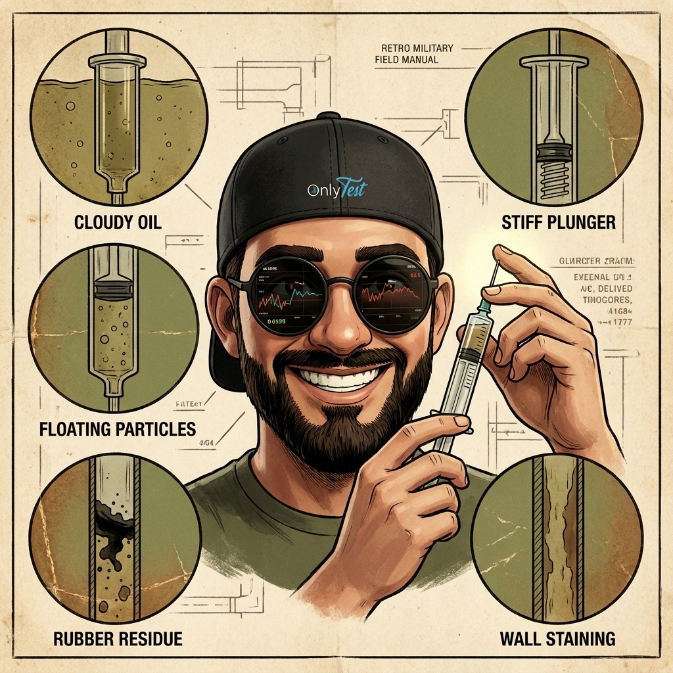
If any of the following apply, tossing that syringe is the right call.
Trying to save a few bucks on gear can lead to an abscess that wipes out months of training altogether.
Does the oil look cloudier or murkier than usual?
Does the plunger feel unusually stiff or catch midway when you push it?
Can you see microscopic particles or debris floating in the oil?
Is there black rubber residue smeared near the needle tip or around the plunger?
Are there smear marks that look like oil stains streaking the inside barrel of the syringe?
If you spot any of these symptoms, ditch it without hesitation.
Honestly, this is where a lot of blowouts happen.
Syringe brand matters quite a bit too.
BD (Becton Dickinson) commands the highest preference among overseas bodybuilders.
Next are Luer-Lock types, and the standard domestic brands like Shinheung or Medical found in local pharmacies are decent enough, as they use a mix of PE and PP.
Conversely, you should avoid unbranded Chinese rigs whenever possible.
They often lack any material code, and the quality of the plunger rubber is wildly inconsistent.
I’ve actually seen plenty of cases where they melted or deformed during long-term pre-loading.
Fortunately for Chul-soo, he spotted the floating debris right before pinning and scrapped the whole batch, ending the crisis there.
But most guys just force it in anyway.
“What’s the worst that could happen?”
That’s how it always starts.
A single barrel of oil pumped in to build muscle faster boomerangs back as late-stage prep inflammation, leaves scar tissue, and ultimately obliterates your entire condition.
The body is far more honest than you think.
It’s not a system that holds up for long when you keep shoving garbage into it.
Bodybuilding isn’t simply a battle of blasting heavy gear and lifting heavy weights.
It’s closer to a war of attrition—how long and how stably you can manage every single variable entering your body.
Ultimately, the athletes who survive to the end aren’t the ones pushing recklessly.
The guys who continuously monitor every micro-chemical reaction happening inside their bodies are the ones left standing at the finish line.